Bedding · Material guide
Latex Mattress Toppers: How Thickness and Feel Shape Your Sleep
A mattress topper is a considered layer, not a magic reset. The right latex topper can soften a firm surface, introduce a little more cushioning, or add a distinct natural-rubber feel—while the wrong thickness or firmness may leave your bed feeling less comfortable than before.
The secret is to judge the topper as part of a whole sleep setup: your mattress, preferred sleeping position, body’s pressure points, bed height, and practical care routine all matter.
What a latex topper can—and cannot—change
A latex mattress topper rests on top of an existing mattress to modify the surface feel. Depending on its thickness, firmness, and construction, it may add cushioning, make a bed feel more responsive, or provide a modest buffer between the sleeper and a mattress that feels too firm. It can also alter how readily the surface gives way beneath the shoulders and hips.
That change has limits. A topper does not repair a sagging or damaged mattress, correct an unsuitable bed base, or reliably transform the underlying support system. If a mattress has a pronounced dip, uneven surface, or failing edges, adding a new layer may disguise the problem briefly without addressing its cause. Think of a topper as a finishing layer: most effective when the foundation beneath it is still in sound condition.
Latex has a springy, buoyant quality that distinguishes it from materials that slowly compress around the body. It responds as weight is applied and tends to recover its shape when that weight shifts. The exact sensation varies by formulation, firmness, thickness, and the mattress below. “Latex feel” is not one universal experience; it is a family of related sensations, from lightly cushioned and lively to more substantial and supportive.
Thickness: a small change or a new bed altogether?
When comparing latex topper thickness, start with the amount of change you actually want. A thinner layer generally makes a more restrained adjustment. It can lend a firm mattress a touch of surface softness without dramatically changing the overall profile. For sleepers who already like their mattress but want a slightly gentler first impression, that subtlety can be the appeal.
A thicker topper usually produces a more noticeable shift. There is more material between the sleeper and mattress, so the surface may feel plusher and pressure relief can become more apparent. That additional depth can be welcome if the existing bed feels unyielding, but it also makes the topper’s character more influential. If its firmness is poorly matched to your preference, a thicker layer may amplify the mismatch rather than resolve it.
Thickness is only one part of the equation. A thick, firm topper can feel quite different from a thick, softer one, and the base mattress continues to shape the result. A mattress that is already soft may allow a sleeper to sink farther into a thick layer. A firm mattress may provide a more stable foundation beneath the same topper. Neither combination is automatically better; the desired balance is personal.
It helps to imagine the bed as a sequence of layers rather than treating the topper as an independent product. The mattress provides the primary support, while the topper changes the feel at the surface. If you are choosing between two thicknesses, consider whether you want a finishing touch or a stronger intervention. When uncertain, a modest adjustment may be easier to live with than a dramatic one, especially if the mattress itself is not familiar to you in combination with latex.
A simple way to frame the choice
- Subtle cushioning: Look at thinner options and a firmness that adds comfort without dominating the mattress feel.
- A more noticeable surface change: Consider a thicker layer, while paying close attention to firmness and the mattress’s existing softness.
- Uncertain foundation: Assess the mattress for sagging or uneven support before expecting a topper to solve the problem.
Firmness is personal—and relative
Latex firmness is often described with words such as soft, medium, or firm, but these labels are not always standardized across manufacturers. A “medium” in one range may not feel identical to a “medium” elsewhere. Even within one product, a topper can feel different depending on the mattress beneath it, the sleeper’s body shape, and how weight is distributed across the surface.
That is why firmness is best considered in context. If your mattress is already quite firm, a softer topper may add welcome give. If the mattress is plush, a firm latex layer may make its surface feel more responsive, although it cannot reliably replace the mattress’s core support. If your bed is comfortable in some areas but too firm at the shoulders, consider whether a topper’s overall softness and depth are likely to address that sensation evenly.
It is also useful to separate “softness” from “support.” A surface may feel gentle at first contact while still having a lively, resilient response. Conversely, a firm-feeling topper may provide less immediate cushioning. The experience is shaped by how the material compresses under you and how quickly it pushes back—not simply by the label on a product page.
When possible, review the manufacturer’s detailed firmness description, construction notes, and return terms rather than making a decision from a single adjective. If you can test a comparable latex material in person, notice how it feels when lying down and changing positions. A quick press with a hand may communicate resilience, but it cannot reproduce the sensation of your full body on the topper.
Sleeping position and pressure preferences
Your usual sleep position can help clarify what you want from a topper, though it should not be treated as a strict rulebook. Side sleepers often pay close attention to cushioning at the shoulders and hips, which meet the surface more directly. A topper that is too firm for their preference may preserve a hard, pressing sensation; one that is too soft may make the bed feel less stable. Thickness and firmness should be considered together.
Back sleepers may prioritize a surface that feels comfortably cushioned without seeming to swallow the body. Stomach sleepers often prefer a more level, less yielding feel. These are broad patterns, not prescriptions: body proportions, mobility, mattress condition, and personal comfort can change the equation. Many people also move between positions during the night, making a balanced, responsive feel more appealing than a surface tailored to only one posture.
Instead of selecting by sleep position alone, ask yourself what you notice on your current bed. Is the surface too hard at first contact? Does it feel overly soft or slow to respond? Are you comfortable when you settle in but dissatisfied when you turn? These observations make more useful starting points than a category label alone. If discomfort is persistent, severe, or associated with a health concern, seek guidance from an appropriate healthcare professional rather than relying on bedding changes as treatment.
Latex versus the mattress underneath
The same topper can produce different results on different mattresses. On a firm mattress in good condition, latex may act as a cushioning layer while preserving much of the underlying support. On a mattress that is already soft, a thick topper may increase the sense of sink. On an older mattress with a dip, the topper may follow the unevenness instead of restoring a level surface.
Before choosing, inspect the bed rather than relying only on how it feels while lying in one spot. Check whether the surface is even, whether the mattress returns to shape, and whether the bed frame or foundation is stable. A weak or unsuitable base can affect the whole sleep setup. If the mattress is past its useful life or has a substantial structural problem, replacing it may be more effective than layering over it.
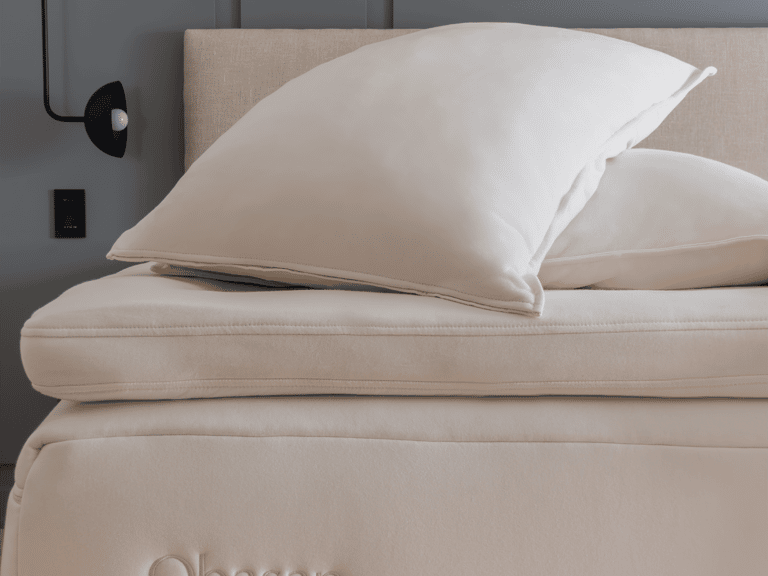
As one example of how latex layering can be integrated into a complete bed, the Obasan Deluxe Dunlop Latex Mattress is described as having a 2.5-inch organic Dunlop latex and wool topper alongside its latex mattress layers. It illustrates that a topper can be part of a broader construction, rather than an isolated add-on. The combined feel of any mattress and topper depends on the full configuration, so this example should not be read as a guarantee of how another topper will perform on a different bed.
Materials, certifications, and clear descriptions
Shopping for organic or natural bedding can bring a thicket of claims. Read the complete material description and identify what the certification applies to. A product may contain natural latex, but that wording alone does not establish that every component is organic or certified. Covers, quilting, adhesives, and other materials may have separate specifications.
For latex products, check whether the manufacturer identifies the type of latex and explains the source of any organic claim. Certifications can provide useful, specific information, but they do not mean every product feature is identical or that a material suits every sleeper. Look for the certification name, the scope of its coverage, and whether it applies to the latex itself, the textile components, or the finished product. If a product page uses a certification term without explaining what it covers, seek clarification before treating it as an all-materials assurance.
It is also sensible to distinguish material standards from performance claims. A certification may concern composition or processing; it does not by itself prove a particular comfort level, cooling effect, or lifespan. Those questions call for separate product details and, where available, clear care instructions and warranty terms.
Descriptions that specify the topper’s thickness, firmness options, cover materials, and care requirements are more useful than broad phrases such as “clean,” “eco,” or “luxury.” A precise description helps you compare like with like and decide whether the claims align with your priorities. If allergy or material sensitivity is a concern, review the component list carefully and consult a qualified professional when appropriate.
Ventilation, covers, and bed height
Construction matters beyond the latex itself. Latex is commonly made with a cellular structure, and many toppers are designed to allow air movement through the material. In practice, the overall temperature experience also depends on the mattress, sheets, room conditions, sleeper, and any protective layers. A breathable material description is worth noting, but it should not be taken as a promise that a topper will keep every person cool.
Check whether the topper comes with a cover, whether that cover is removable, and whether it can be washed. A fitted sheet or mattress protector may affect how the topper feels and how easily it stays in place. Confirm that the cover and any protector are compatible with the topper’s dimensions and intended care. A tight protector can change surface sensation, while a loose cover may shift or bunch. Follow the manufacturer’s instructions rather than assuming that all covers can be machine washed.
Thickness also adds height to the bed. That can affect fitted-sheet depth, the ease of getting in and out, the look of the mattress on its frame, and the alignment of headboard or bed rails. Measure your mattress and account for the topper before buying sheets or protective covers. If the bed is already high, even a comfortable additional layer may make daily use less convenient.
For couples, consider whether both sleepers want the same surface change. A topper across the full bed creates one shared feel, which may not suit people with different firmness preferences. Some mattress systems offer more individualized configurations, but not every topper is designed for split use. Check dimensions and the manufacturer’s guidance before assuming two separate layers will sit securely or behave as intended.
Care and everyday expectations
Care instructions are part of the purchase decision, not an afterthought. Latex products can have specific requirements around washing, moisture, sunlight, heat, and handling. Do not assume a latex core is machine washable simply because a removable cover can be laundered. Follow the product’s own directions and ask the manufacturer about anything unclear.
A protective cover can help reduce direct contact with spills, sweat, and everyday wear, but it should be compatible with the topper and used as directed. If you need to clean the surface, use only the recommended method. Avoid exposing latex to direct heat or sunlight unless the manufacturer explicitly advises otherwise. Let any cleaned component dry fully before putting it back into use.
Consider how you will store or move the topper, too. Latex can be substantial, and a thicker piece may be less convenient to lift, rotate, or fit into storage. Before purchase, review the delivery details, dimensions, warranty, trial period, and return policy. Policies vary, and bedding products may have specific conditions for return or exchange. Understanding those terms beforehand makes it easier to judge the decision calmly rather than by first-night impressions alone.
A practical checklist before you choose
Use this short checklist to bring the decision back to the details that matter in your own bedroom:
- Assess the mattress: Is it even and supportive, or is it sagging, damaged, or uncomfortable in a way a topper cannot address?
- Name the change: Do you want a slight cushion or a more pronounced alteration to the surface feel?
- Compare thickness and firmness together: Neither measurement tells the whole story on its own.
- Factor in your sleep habits: Consider your usual position, how often you move, and where you prefer more or less cushioning.
- Read the materials carefully: Verify what the latex, cover, and certifications actually describe.
- Check fit and height: Measure the bed and confirm sheet, protector, and frame compatibility.
- Review care and return terms: Make sure routine maintenance and the purchase policy suit your needs.
The considered choice
A latex mattress topper is most satisfying when its role is clear. A thin layer may offer a discreet adjustment; a thicker one can make the bed feel meaningfully different. Firmness shapes the experience, but it is always interpreted through the mattress beneath it and the person sleeping on it. Material descriptions, certification scope, cover compatibility, and care requirements complete the picture.
Rather than searching for a universally perfect thickness, begin with the sensation you want to change. Make sure the mattress is a suitable foundation, compare the topper’s firmness and depth, and verify the details that affect daily use. The most elegant sleep setup is rarely the one with the most layers. It is the one in which every layer has a purpose—and the bed feels right to you.