Nursery · Sleep essentials
Choosing a Crib Mattress: Materials, Firmness, and Care
A crib mattress is one of the nursery’s most important foundations: quietly practical, used every day, and worth choosing with care. Fit, firmness, construction, and maintenance matter more than elaborate extras. Here is how to assess the details—and how the Obasan Organic Crib Mattress can serve as a reference point when comparing materials and specifications.
Preparing a nursery often involves a thousand small decisions, from the softness of a blanket to the colour of the walls. But the most considered choice may be the least decorative: the surface where a baby sleeps. A well-chosen crib mattress should fit the crib properly, remain firm and level, and be used according to current safe-sleep guidance. Its materials and care requirements also deserve a closer look, particularly if you are comparing natural or certified-organic options.
“Organic” can be a useful starting point for asking questions about materials and production, but the word alone does not establish that a mattress is suitable for an infant or that it meets every safety requirement. Start with the fundamentals: confirm that the mattress is designed for the crib, check the fit and firmness, read the manufacturer’s instructions, and follow up-to-date advice from recognized child-health and product-safety authorities in your region.
This guide considers those fundamentals through the example of the Obasan Organic Crib Mattress. Its listed construction includes organic Dunlop latex, rubberized coconut fiber, cotton, and wool. Understanding what these components are intended to do—and what claims they do not make—can help caregivers compare options with clarity rather than relying on a label or a polished description alone.
Begin with fit, not finish
Before considering fibre content or colour, confirm that a mattress is the right size for the specific crib. A close, secure fit helps prevent hazardous gaps between the mattress and the crib sides. Do not assume that every product described as “standard” will fit every crib: check the crib’s manual, the mattress dimensions, and any instructions supplied by the mattress maker.
The Obasan model is listed at 28 by 52 inches and 4.5 inches thick, dimensions described as fitting standard North American cribs. Those measurements are a useful comparison point, not a substitute for checking your own crib. Manufacturing tolerances and crib construction can vary, so follow the crib manufacturer’s directions for evaluating fit. If the mattress appears too small, does not lie flat, or leaves a concerning gap, do not try to correct the mismatch with added padding or improvised materials.
Fit is also affected by the support beneath the mattress. A crib frame should be sturdy, level, and assembled as its manufacturer instructs. The Obasan product guidance recommends a slatted crib base or a solid wood base with perforations to allow airflow, and notes that the base needs to provide adequate support. Check that the mattress is not bowed or unstable once installed. If the crib has a solid, unperforated platform, consult the crib and mattress manufacturers about compatibility rather than modifying the base on guesswork.
As your baby grows, adjust the crib’s mattress height according to the crib manual. The sleep surface should remain appropriately positioned and secure within the frame. A mattress that fits well on day one still needs periodic checks, especially after moving the crib, changing its configuration, or reinstalling components.
Why firmness matters
For an infant, a crib mattress should provide a firm, even surface. Firmness is not simply a matter of adult comfort or personal preference. A cushioned, deeply yielding surface may feel inviting to a grown-up hand, but infant sleep recommendations prioritize a firm, flat surface without soft additions. Follow current safe-sleep guidance from your public-health authority and the instructions for the crib and mattress.
Descriptions such as “supportive,” “pressure-relieving,” or “comfortable” can be difficult to interpret in a nursery context. Look for clear information about the intended use and firmness of the complete mattress, rather than judging only one material or layer in isolation. Ask whether the assembled product is designed specifically for a crib and whether the manufacturer provides age-appropriate use instructions. The important question is how the finished sleep surface performs, not whether an individual component feels soft or springy when handled.
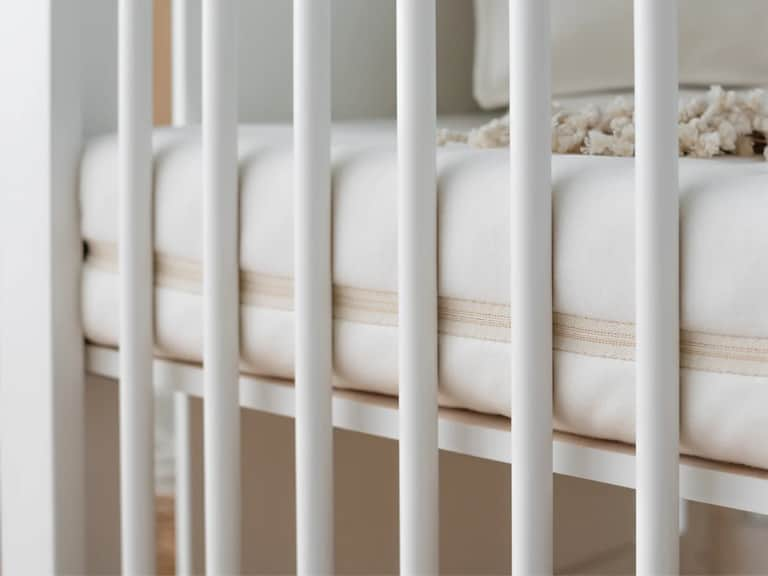
The Obasan mattress is described as having dual two-inch layers: an extra-firm organic Dunlop latex layer and a rubberized coconut-fiber base, with wool and cotton also included in its construction. The manufacturer presents these layers as providing firm support. That description can help readers understand the intended design, but it should not replace checking the mattress’s fit, condition, product documentation, or relevant safety requirements.
Keep the sleep space simple. Do not add pillows, toppers, positioners, loose blankets, soft toys, or other unapproved products to make a firm mattress feel more plush. Use only a fitted sheet intended to fit the mattress snugly, and follow current safe-sleep recommendations for every sleep. A mattress protector or moisture pad should be used only if it is designed to fit securely and is compatible with the mattress and the crib guidance.
Understanding the materials
Natural materials are often chosen for their origin, texture, or approach to manufacturing. Their presence does not automatically determine safety, durability, or performance; those depend on the finished construction, product testing, care, and how the mattress is used. A thoughtful comparison looks at each material’s role, the certifications provided, and the manufacturer’s instructions.
Dunlop latex
Latex is made from rubber, and the Dunlop process is one method used to produce latex foam. In the Obasan crib mattress, the product information identifies organic Dunlop latex as one of the two-inch layers and describes that layer as extra firm. Buyers comparing latex mattresses can ask how the material is sourced and processed, what certification applies, and whether the certificate covers the relevant component or the finished product. Be precise about the wording: a material certification is not automatically a blanket endorsement of every aspect of a mattress or proof of a particular health outcome.
Coconut fiber
The mattress description lists a rubberized coconut-fiber base. Coconut coir is a plant-derived fibre that can be formed into a supportive layer; in this product, the rubberized construction is identified as part of the mattress’s firm foundation. When comparing coir or coconut-fibre products, check what binds the fibres together, how the layer is enclosed, and whether the manufacturer specifies cleaning or moisture precautions. The name of a plant fibre alone does not tell you the complete composition of the layer.
Cotton
Cotton is listed in the mattress construction and is also identified in the product information as part of its breathable cover. Cotton’s feel and performance depend on how it is woven, treated, and incorporated into the assembly. If organic certification matters to you, look for the exact certification claim and its scope. A certification attached to cotton does not necessarily certify every other layer or the mattress as a whole.
Wool
Wool is described as a moisture-wicking component intended to contribute to temperature control, and as an all-natural fire barrier in the product information. In a mattress, wool may be used as a fibre layer as well as part of a product’s flame-resistance design. Families should still rely on the product’s documentation and applicable regulations rather than assuming that a material claim by itself proves compliance. If you have questions about the fire barrier, ask the manufacturer for the precise safety and certification information relevant to the model you are considering.
Across all four materials, the practical task is to distinguish a description from a verified specification. Review product labels, certification records, the stated composition, and any applicable test or compliance information. If a claim is broad or unclear, contact the manufacturer for clarification before making a decision.
What certifications can—and cannot—tell you
The Obasan Organic Crib Mattress is listed as using GOTS- and GOLS-certified organic materials. Such certification language may help explain how certain fibres or materials are assessed within defined standards, but shoppers should check the certificate itself and verify what it covers. Is the claim about the latex, textile components, processing, or the complete finished item? Are the certification and product details current? Clear documentation matters more than a logo viewed out of context.
Certification is one part of a careful review, not a replacement for safety assessment. It does not mean that a mattress is automatically suitable for every crib, that it needs no maintenance, or that it can be used with any accessory. Nor should “natural,” “organic,” or “chemical-free” be treated as a guarantee of a specific health benefit. These terms may refer to different things, so compare the exact claims and their supporting documentation.
When evaluating a product, consider a short list of questions:
- Is the mattress specifically made for use in a crib and compatible with the crib model?
- Are the dimensions and thickness clearly stated?
- Is the complete sleep surface described as firm and flat?
- Are materials and certification claims explained in enough detail to verify?
- Are care instructions and limitations readily available?
- Can the manufacturer provide current safety or compliance information when requested?
Answers to these questions create a more useful picture than a single headline claim. They also make it easier to compare a natural-material mattress with another option built from different materials but designed for the same purpose.
Breathability and temperature: practical context
Breathability is a common feature in nursery product descriptions. Cotton, wool, latex, and fibre-based layers may be discussed in relation to airflow or moisture management, but those qualities should be considered alongside the whole sleep setup. The fit of a sheet, the room environment, a baby’s clothing, and the way the mattress is supported all matter. No material should be treated as a way to compensate for an unsuitable crib, an unsafe sleep arrangement, or a baby who appears too hot or unwell.
The Obasan description highlights breathable cotton and moisture-wicking wool. These are construction details worth noting if you are comparing materials, particularly when reading about how the product is designed. They are not a reason to add loose bedding or to depart from safe-sleep guidance. Dress a baby appropriately for the room and follow the advice of your child’s clinician or public-health authority if you are concerned about temperature or comfort.
Similarly, terms such as “hypoallergenic” or “antimicrobial” should be read with care. They can mean different things across product categories and may not predict how an individual baby will respond. A material choice cannot eliminate every possible sensitivity. If your child has a known allergy or a health concern, seek advice from an appropriately qualified healthcare professional and ask the manufacturer for complete material information.
Care that protects the mattress—and its instructions
Care is not an afterthought. A mattress may contain layers that should not be soaked, machine-washed, or exposed to high heat. Before placing a new product in the crib, read its care instructions, keep them accessible, and note any opening or unpacking deadlines. For the Obasan model, the manufacturer advises opening the mattress within 30 days of receipt. That detail is easy to overlook in the excitement of preparing a nursery, but it is part of the product’s stated setup guidance.
The Obasan instructions recommend protecting the mattress with an Obasan wool moisture pad or an equivalent protector. If you use a protective layer, make sure it is intended for a crib mattress and fits securely without bunching or creating a gap. Follow the crib maker’s advice as well as the pad and mattress instructions. Avoid adding improvised layers or anything loose to the sleep surface.
For a spill or mark, the manufacturer’s care guidance says to unzip the outer cover and spot-clean by gently scrubbing with light soap and very little water. It advises against washing the mattress components and recommends air-drying them. It also says not to place the mattress in direct sunlight or near a direct heat source. These instructions are specific to this product; another mattress may require different handling, so do not generalize one brand’s care routine to all materials.
The product information notes that the removable cover may be aired seasonally without the rubber core, and that the mattress casing may be environmentally dry-cleaned if needed. It also cautions that the outcome of dry cleaning is not guaranteed. Before removing any cover or layer, check the manufacturer’s directions and ensure that all components are correctly reassembled before the mattress returns to the crib.
Promptly address moisture according to the manufacturer’s directions, and allow the mattress to dry fully before use. Do not wash, saturate, steam, or apply cleaning products unless the instructions explicitly permit it. A simple routine—using an appropriately fitted protector, checking the surface, and responding to spills with the approved method—can make upkeep more manageable without compromising the construction.
A measured look at the Obasan Organic Crib Mattress
The Obasan Organic Crib Mattress offers a useful example of how product details can be read as a complete set rather than as isolated selling points. The listing describes a Canadian-made mattress with certified organic Dunlop latex, rubberized coconut fibre, cotton, and wool. It specifies two layers of two inches each: an extra-firm latex layer and a coconut-fibre base, and gives the overall dimensions as 28 by 52 inches and 4.5 inches thick. It also describes a removable outer cover for spot cleaning and a 10-year limited warranty.
Those features may appeal to families looking for a natural-material construction, but comparison should remain grounded in the practical questions that apply to any crib mattress. Confirm that the dimensions work with the crib, read the manufacturer’s setup and base recommendations, understand the care restrictions, and inspect the documentation behind certification and safety claims. A long warranty can be reassuring about the company’s stated coverage, but it does not replace safe use, proper fit, or checking the terms and exclusions.
In particular, the product’s material choices should not distract from the essentials: a stable crib base, a firm and flat mattress, an appropriate fitted sheet, and a sleep space kept clear of loose items. The most thoughtful nursery is not the one with the most elaborate claims. It is the one where each choice is understood and used as intended.
A simple comparison checklist
As you compare crib mattress materials, keep a compact checklist nearby. It can help you look beyond broad phrases and return to the details that influence everyday use.
- Fit: Compare the mattress dimensions with the crib manual and confirm a snug, level fit.
- Firmness: Choose a firm, even sleep surface intended for infant use; do not add softness with extra layers.
- Construction: Identify the role of each layer, including latex, coconut fibre, cotton, wool, or other materials.
- Certifications: Check the certificate, its validity, and exactly which materials or processes it covers.
- Base compatibility: Follow the crib and mattress instructions for support, ventilation, and assembly.
- Care: Know whether the cover is removable, how spot cleaning works, and which methods are prohibited.
- Protection: Use only a securely fitted protector approved for the intended crib setup.
- Warranty: Read the duration, coverage, exclusions, and steps required to make a claim.
- Current guidance: Follow the latest safe-sleep recommendations in your location and consult a healthcare professional about individual concerns.
The considered choice
Choosing a crib mattress is an exercise in prioritizing what matters. Materials tell part of the story; dimensions, firmness, construction, support, safety information, and care instructions complete it. An organic or natural-material option may align with a family’s preferences, but the best decision is one made with precise information and a clear understanding of how the product is meant to be used.
The Obasan Organic Crib Mattress brings together latex, rubberized coconut fibre, cotton, and wool, with published details about its dimensions, base recommendations, spot-cleaning method, and warranty. Treat those details as a starting point for comparison: verify the fit with your crib, review the certification and safety documentation, and follow the manufacturer’s instructions from setup through routine care.
Most of all, keep the sleep space simple and follow current safe-sleep guidance every time your baby is put down to sleep. A carefully chosen mattress is one part of a secure nursery environment—its value lies in being the right fit, appropriately firm, correctly supported, and maintained as intended.